
When Tory Loney learned during pregnancy that her daughter would be born with a serious heart defect, she knew her family faced an uncertain road ahead.
At about 22 weeks’ gestation, prenatal testing indicated that Noahlyn Loney would be born with hypoplastic left heart complex, a congenital heart condition that requires cardiac procedures during the newborn period.
Tory Loney and her husband, Cory, who live in the south-central Iowa community of Melcher-Dallas about an hour southeast from Des Moines, transferred to University of Iowa Health Care.
"When we first found out that Noahlyn would need highly specialized care, we were like, ‘Yes, send us to UI Health Care. We know we'll be in good hands,’” Tory Loney says.
That confidence would prove crucial.
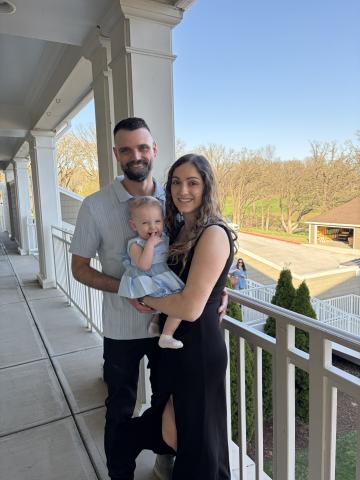
After Noahlyn was born in March 2025, specialists at UI Health Care Stead Family Children's Hospital moved quickly to evaluate her condition. Within a week, doctors discovered not only smaller structures on the left side of her heart but an anomalous left coronary artery. It was an extremely rare combination of congenital heart defects.
“With Noahlyn, all the structures on the left side of her heart were small,” says UI Health Care Stead Family Children’s Hospital pediatric cardiologist Benjamin Reinking, MD, clinical professor and director of the pediatric cardiology division in the Stead Family Department of Pediatrics. “With some kids, the left side of the heart is so small that it will never be able to do the job it’s supposed to. But in Noahlyn’s case, we determined that through a series of surgeries, we could get her heart functioning as close to normal as possible.”
A major complicating factor was that one of Noahlyn’s coronary arteries that supply blood to her heart arose from the wrong spot, Reinking notes, and needed to be re-implanted — adding a layer of complexity to her care.
Noahlyn underwent her first open-heart surgery within days of birth — the first of several procedures she would undergo over the course of an 83-day hospitalization. She later developed a membrane under her aorta that surgeons removed right around the time of her first birthday.
Today, the 18-month-old is doing well.
"Anyone who doesn't know that Noahlyn had these surgeries and can’t see her scar would never know," Tory Loney says.
For families like the Loneys, having access to highly specialized pediatric cardiology care not available anywhere else in Iowa — and relatively close to home — is reassuring. UI Health Care is the only health system in Iowa that provides pediatric heart transplant and single-ventricle heart surgery services.
"We're the only comprehensive pediatric cardiology program in Iowa," says Gary Beasley, MD, clinical associate professor and medical director of the pediatric transplant and heart failure program at Stead Family Children’s Hospital. “For many Iowa families, receiving a comparable level of expertise would require traveling out of state.”
Now, UI Health Care has expanded access to this expertise through additional pediatric cardiology services at its Urbandale, Iowa, clinic — making care more convenient for families throughout central and western Iowa.
Bringing specialized expertise closer to home
In September, UI Health Care expanded pediatric cardiology services in Urbandale with a general pediatric cardiology clinic operating two days each week. The clinic offers echocardiograms, electrocardiograms (EKGs), and general cardiology evaluations — complementing existing transplant follow-up care and electrophysiology services already available at the Urbandale location.
The expansion reflects both a growing need and a longstanding commitment to making care more accessible to Des Moines and the surrounding areas, including central and western Iowa. Having pediatric cardiology expertise more easily available in these parts of the state helps families avoid long drives for routine evaluations, urgent assessments, and follow-up care.
“We'll be able to accommodate all the planned visits, but we'll also be able to help patients when they want to run track, for example, and they need a letter signed within a week,” Reinking says. “The Urbandale clinic makes all of the unplanned, non-urgent things much easier.”
Such convenience is meaningful for the families of patients like Noahlyn who require frequent visits during the first few months of life.
“These types of patients are typically seen every two weeks until they're about 6months old,” says Trudy Pierick, MSN, ARNP, a pediatric cardiology nurse practitioner at Stead Family Children’s Hospital who manages care for children with complex congenital heart disease. “For working families, that’s a huge thing to have to travel four to six or more hours a day, several times a month, to an appointment.”
For Noahlyn's family, the Urbandale clinic has already made a difference. During periods when frequent lab testing was required, the central Iowa location helped reduce travel demands.
“At one point, Noahlyn needed blood draws every couple of days, so it's been great having the Urbandale clinic available,” Tory Loney says.
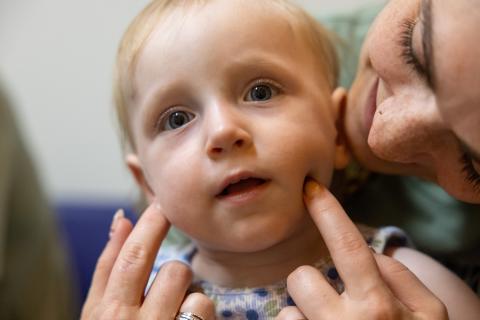
A second chance at life
The value of specialized pediatric cardiac care — and the convenience of the Urbandale clinic — is also reflected in the story of Jaylee Bartleson of Nevada, Iowa.
Born in July 2018 and weighing just over 4 pounds, Jaylee faced medical challenges from the beginning. Initially, doctors monitored a small brain bleed that resolved on its own. After several months, however, Jaylee struggled to gain weight. She was lethargic, frequently vomiting, and falling behind her developmental milestones. One night, her condition worsened dramatically.
“I could hardly get her to move,” says Jaylee’s mother, Kelli Bartleson. “I'm like, ‘This isn't right.’”
After multiple medical visits, an echocardiogram revealed devastating news: Jaylee was in severe heart failure. At just 6 months old, she was diagnosed with dilated cardiomyopathy, a condition that causes the heart’s ventricles to stretch and become thin, making it much harder to pump blood to the rest of the body.
Within days, Jaylee was transferred to Stead Family Children’s Hospital. Her care team initially tried medication treatments, but her heart function remained critically low.
"We eventually had to start talking about transplant," Bartleson says.
In February 2019, Jaylee underwent surgery to receive a ventricular assist device (VAD), a mechanical pump that kept her alive while she waited for a donor heart. She remained on the device for 73 days.
Jaylee received a heart transplant in April 2019. She was 10 months old. Hours after surgery, however, she experienced cardiac arrest and needed ECMO (extracorporeal membrane oxygenation) for four days. ECMO provided temporary life support by pumping and oxygenating Jaylee’s blood until her transplanted heart could fully function on its own.
Now 8 years old, Jaylee “has had some other, less serious, complications, but she’s taken more steps forward than backward," Kelli Bartleson says. “She’s happy. She's going to school. She rides the bus. She has so many friends. She’s doing really well."
Expertise that spans a lifetime
Beasley notes that Jaylee needs and continues to receive a level of highly specialized care at UI Health Care’s university campus that only a handful of centers can provide. And even after a successful transplant, care continues indefinitely.
"Young patients like Jaylee are seen every three to six months for the rest of their lives," Beasley says.
Many services are now available at the Urbandale location, including echocardiograms, laboratory testing, and follow-up visits. This reduces travel demands for the Bartlesons and other families who are often balancing appointments with multiple specialists.
“If it's only a cardiology-related appointment, we go to the Urbandale clinic,” Kelli Bartleson says. “It's much easier. We don't have to take off as much time for work, and we’re not on the road for four hours on each appointment day.”
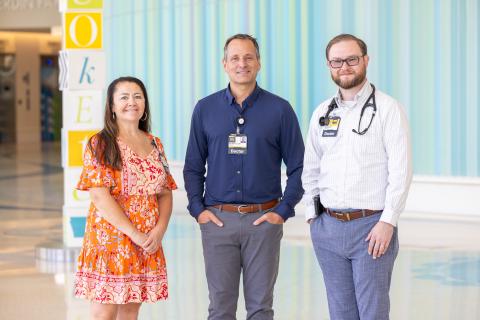
The Urbandale clinic also strengthens communication among providers.
“We would sometimes do a video visit with patients who live at greater distances, but those aren't always perfect," Beasley says. "Now, I have a physician colleague [in Urbandale] who I know and trust who can see these kids more quickly.”
That collaborative approach is something families often notice firsthand. Kelli Bartleson notes that Jaylee has a large care team, representing various pediatric specialties, whose goal is coordinated care and follow-up.
“Jaylee’s UI Health Care team listens to me, and they take our advice. And the Urbandale clinic is a good example of how they work together to take care of her and make it easier for us as a family,” Bartleson says.
Iowans caring for Iowans
For the pediatric cardiology team, caring for children with life-altering heart conditions is a long-term commitment that often begins before birth, when congenital heart defects are first identified, and continues into adulthood.
Reinking emphasizes coordination of care for both mother and baby within the same health system. The care team’s connection to Iowa also shapes its approach. Many of the team’s clinicians have personal ties to the state and understand the challenges families face.
“We have really smart, talented people who are here because they want to be in Iowa,” Reinking says. “They’re invested in the program because they want to do their best in taking care of Iowans.”
For Pierick, the greatest reward comes from building relationships over time.
“What drives me is meeting families where they are and watching them go through a chronic journey,” she says. “I’ve seen many kids who now have graduated college or beyond.”
Those relationships, combined with leading-edge expertise and a growing presence in central Iowa, allow UI Health Care to support families through every stage of a child's heart condition, treatment, and long-term follow-up.
This commitment resonates with Beasley, who also lives with congenital heart disease.
“It's not only a team that I work with every day,” he says. “It’s a team I trust with my own life.”