The brain receives streams of information that continuously monitor what is happening inside the body. Information from the gastrointestinal tract, heart, lungs, and other internal organs travels through the vagus nerve to a region of the medulla called the nucleus of the solitary tract (NTS). Although this region is small, it contains many different types of neurons with distinct connections and functions. Distinguishing these neuronal subtypes is necessary to understand the neural-circuit mechanisms controlling appetite, breathing, circulation, digestion, and other homeostatic processes.
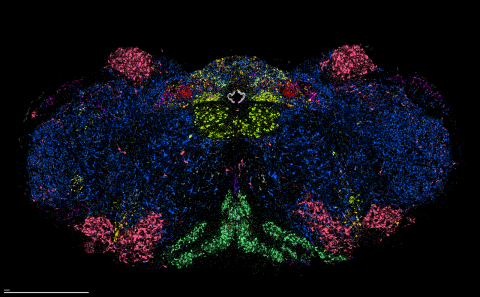
This image from the lab of Joel Geerling, MD, PhD, associate professor in the Department of Neurology, shows an example of multiplexed error-robust fluorescence in situ hybridization (MERFISH), which allows the Geerling team to identify and distinguish subtypes of neurons. Labeling the expression of many genes simultaneously allows the researchers to distinguish cells based on their molecular identities and spatial distributions. This image — produced by Haidong Zhu, a graduate research assistant in the Geerling lab — shows just a small number of transcriptional markers from the larger MERFISH dataset in one tissue section from the lower brainstem, including the NTS. Each colored dot represents a specific mRNA transcript. Using MERFISH and several other techniques, the research team is identifying neuronal subtypes that receive interoceptive information and coordinate distinct autonomic reflexes and behaviors. Geerling and his colleagues hope to use this information to identify new therapeutic opportunities for disorders affecting appetite, breathing, cardiovascular control, and digestion.