
Rare poisonings. Complex drug exposures. Life-threatening overdoses. At University of Iowa Health Care, these cases are not all that uncommon.
The Division of Medical Toxicology, which includes both an outpatient referral clinic and a bedside consultation service, manages roughly 900 unique cases each year. As Iowa's only tertiary care center for medical toxicology, the team provides around-the-clock expertise for some of the state's sickest patients. For a specialty many people have never heard of, demand for its services is remarkably high.
Medical toxicologists specialize in diagnosing and managing illnesses caused by drugs, chemicals, occupational and environmental toxins, and radiological or biological agents. Their expertise allows them to anticipate complications, tailor treatment plans to a patient's unique medical history, and guide critical clinical decisions.
The division's role today stands in stark contrast to the landscape just a decade ago.
Few people understand that transformation better than Dan McCabe, MD, a clinical associate professor of emergency medicine at the University of Iowa, director of the Division of Medical Toxicology at UI Health Care, and medical director of the Iowa Poison Control Center.
Before 2016, an Iowan exposed to a dangerous chemical, toxic drug interaction, or environmental poison had little chance of seeing a medical toxicologist in person. Although the state was home to one board-certified specialist, located at the Iowa Poison Control Center in Sioux City, the demand for consultation was so great that care could only be delivered remotely. For patients facing complex or life-threatening exposures, a face-to-face evaluation simply wasn't an option.
"For a state the size of Iowa, the lack of in-person access left a significant gap in care for patients and providers alike," says McCabe, who also holds a secondary faculty appointment in the UI College of Pharmacy. "Because no two patients respond to an exposure in exactly the same way, direct evaluation can provide insights that are difficult to capture through a phone consultation alone."
Building a specialty from the ground up
That changed in 2016, when UI Health Care emergency medicine physician Josh Radke, MD, returned to Iowa and established the state's first bedside medical toxicology consultation service.
For the first time, Iowans with complex poisonings, overdoses, and toxic exposures could be evaluated in person by a medical toxicologist.
The service continued to expand after McCabe joined UI Health Care in 2019. With two toxicologists on staff, the program was able to provide around-the-clock coverage, an unprecedented level of access to medical toxicology expertise in Iowa.
As demand grew, so did the team. Additional faculty joined the service, and in 2022 the Department of Emergency Medicine formally established the Division of Medical Toxicology. That same year, McCabe became the medical director of Iowa Poison Control Center. The following year, UI Health Care emergency medicine physician Joshua Trebach, MD, joined him as associate medical director, strengthening the connection between the state's only poison center and its only academic medical toxicology program, whose toxicologists also serve as consulting physicians for a neighboring regional poison center.
The division grew again in 2023 with the launch of Iowa's first and only medical toxicology fellowship program and the opening of Iowa's only outpatient medical toxicology clinic, one of just a handful in the Midwest.
Held twice each month, the referral-based clinic provides evaluation and follow-up care for patients with chronic or non-emergent toxic exposures that often fall outside the traditional health care system. The same medical toxicologists who staff the outpatient clinic also provide bedside consultations for hospitalized patients at UI Health Care.
“Prior to opening the clinic, there really wasn't a place for many of these patients to go," McCabe says. “Outpatient providers would commonly call the poison center to ask whether there was any way a patient could be evaluated by a toxicologist, and until this clinic opened, the answer was always no. The medical toxicology and Iowa Poison Control Center teams see the clinic as a way to partner with colleagues to make their jobs easier and patient care smoother.”
Today, the division includes five board-certified medical toxicologists, a physician associate, and a fellow working together to provide inpatient consultations, outpatient care, education, research, and support for the Iowa Poison Control Center.
Expanding access across Iowa
The division's growth has done more than increase the number of medical toxicologists in Iowa. It has transformed how patients and providers across the state access specialized expertise.
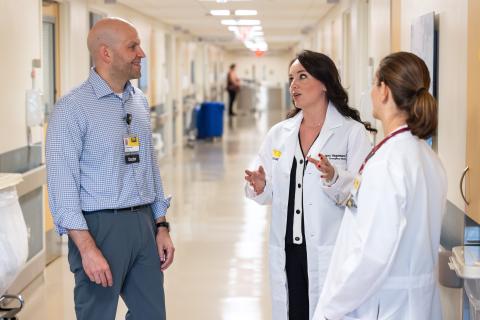
For primary care providers and specialists, the clinic offers a trusted referral destination for patients with complex exposure concerns that may fall outside the scope of traditional medical training. Many of those cases involve questions that local providers rarely encounter, leaving patients searching for answers and physicians navigating significant uncertainty.
One example is lead poisoning. Iowa consistently ranks among the states with the highest rates of lead poisoning in both children and adults, making lead exposure a significant public health concern. As a result, the division has developed extensive expertise in evaluating the clinical effects of lead exposure and guiding treatment for patients across the state. The team consulted on more than 80 lead-related cases last year alone.
"These things that we take care of every day, most providers in the community may see once in a career," McCabe says. "We see ourselves as partners with providers throughout the state."
This partnership allows local physicians to connect patients with specialized expertise while remaining involved in their ongoing care. After a comprehensive evaluation, the toxicology team provides detailed recommendations that help guide management long after the visit is over.
"If my job can offload their job a little bit, then I can essentially be an advocate for other providers throughout the state," McCabe says. "It's better and more efficient patient care for them to come see us for an hour in the clinic, work through the uncertainty, and then send a detailed note back to the provider."
Caring for patients affected by toxic exposures rarely falls to a single specialty. The division works closely with emergency medicine physicians, psychiatrists, addiction medicine specialists, intensive care teams, pharmacists, bedside nurses, social workers, outpatient providers, and public health officials. Together, they address not only the immediate effects of an exposure, but also the circumstances that contributed to it, whether that means substance use disorder, self-harm, an occupational hazard, or an environmental concern.
"I think if I'm the proudest of anything that we do besides bettering patient outcomes and care, it's that we don't work in a silo," McCabe says. "People see that our department is emergency medicine, but we'll work in any setting that the patient is in and with any provider to try to help. We have a team that is extremely high-functioning and devoted."
The division's reach extends even further through the Iowa Poison Control Center, which received over 27,000 calls in 2025 from health care providers, first responders, and families seeking guidance on poisonings, medication overdoses, adverse drug reactions, and environmental exposures.
As demand for services continues to grow, the division has also found new ways to expand its capacity. In 2024, physician associate Jami Hagemann joined the team in what is believed to be one of the nation's first advanced practice provider roles dedicated to medical toxicology.
"I saw that there was potentially a need that I could help fill," Hagemann says. "Knowing that this work can help provide patients with an opportunity to move forward is especially meaningful to me."
Working under the direct supervision of board-certified medical toxicologists, Hagemann helps expand the division's clinical and educational reach while completing a rigorous toxicology training pathway developed within the division.
"Jami came to me and our chair with a plan and very specific tasks she wanted to do," McCabe says. "Because she took that initiative, we've developed a multi-year training curriculum where she learns and engages with medical toxicologists outside of patient care duties and is able to foster deep expertise."
Innovative roles like Hagemann's may help address health care workforce shortages and expand access while maintaining the high level of expertise patients and providers rely on.
Looking ahead
The team remains focused on identifying new ways to care for patients affected by poisonings, self-harm, substance use disorders, and adverse drug reactions.
Many of those patients belong to vulnerable populations whose needs extend beyond a single hospital visit. The team continues to collaborate with psychiatry, addiction medicine, emergency medicine, and primary care providers to identify at-risk patients earlier and connect them with appropriate resources.
The team is also developing new approaches to caring for patients experiencing alcohol withdrawal and recently expanded its efforts to address Iowa's opioid crisis.
Through an Iowa Health and Human Services opioid settlement grant, the Iowa Poison Control Center launched the Iowa Buprenorphine Education, Access, and Consultation Network, or I-BEACON. The initiative provides education and consultation for health care providers who may be unfamiliar with initiating treatment for opioid use disorder.
"Many providers aren't comfortable starting these medications," McCabe says. "And even if they are comfortable starting treatment, they may not know where to send patients for ongoing care."
For McCabe, efforts like I-BEACON reflect a broader philosophy that has guided the division's growth from the beginning: Specialized expertise should be available not only in Iowa City, but throughout the state.
"If medicine's goal is improving patient outcomes, my goal is helping through whatever means my expertise allows," he says.
What keeps medical toxicologists busy?
- Medication overdoses and ingestions
- Self-harm related exposures
- Alcohol withdrawal
- Substance use and drug withdrawal
- Accidental poisonings in children
- Adverse drug reactions
- Lead and heavy metal exposure
- Occupational chemical exposures
- Pesticide and solvent exposure
- Environmental toxin concerns
- Preparedness related to hazmat scenarios
- Snake, spider, and other envenomations
- Toxic gas exposures
- Food-borne toxins
- Toxic plant ingestions
- Marine toxins
- Chronic or remote toxic exposures