

When University of Iowa Health Care cardiac electrophysiologist Peter Farjo, MD, MS, (23F), sees a patient with atrial fibrillation (Afib), he isn't just thinking about the heart.
He’s also considering cancer risk, kidney disease, inflammation, stroke, and other health conditions that can shape a patient's outcome.
“Patients don't just come in with atrial fibrillation,” says Farjo, a clinical assistant professor at the UI Department of Internal Medicine and associate director of the clinical cardiac electrophysiology fellowship training program in the department’s cardiovascular medicine division. “They come in with a history of other medical conditions.”
Using large, national health care databases containing records from millions of patients, Farjo studies how Afib interacts with other diseases and how those interactions influence treatment decisions and outcomes. He looks for patterns to better understand risk, optimize therapies, and identify patients who may benefit from earlier interventions.
One area Farjo studies is the relationship between Afib and cancer. Working with collaborators, including UI electrophysiologist Paari Dominic MBBS, MPH, (12F), Farjo examined patients who had newly diagnosed Afib but no prior history of cancer. Researchers followed the patients over time and found higher rates of subsequent cancer diagnoses compared to similar patients without Afib.
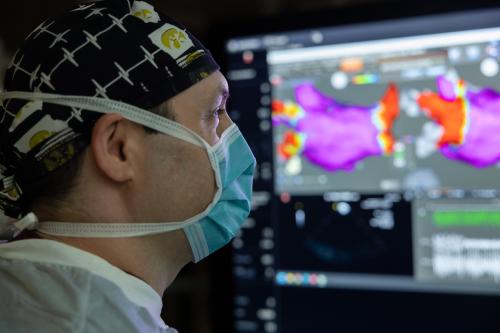
The association was particularly notable among younger adults. While cancer risk generally increases with age, the connection between Afib and future cancer diagnoses appeared strongest in patients between ages 30 and 50.
“What we’re really seeing is the effect of overall cardiometabolic health,” Farjo says. “Factors like obesity, diabetes, hypertension, and chronic inflammation can contribute to atrial fibrillation, and many of those same factors are also associated with cancer.”
That broader view has practical implications for patient care. Rather than focusing exclusively on controlling heart rhythm, physicians increasingly recognize the importance of treating the conditions that surround Afib. Managing blood pressure, improving diabetes control, treating sleep apnea, exercising regularly, maintaining a healthy weight, and staying current with preventive screenings all play an important role.
The same philosophy guides Farjo's work on stroke prevention, another major focus of his research. Because Afib significantly increases stroke risk, patients often require lifelong blood-thinning medications. Others may qualify for a device called a Watchman, an implanted device that blocks a small pouch in the heart where most AFib-related blood clots form.
Farjo studies how these different treatment strategies perform in patients with complex medical conditions to better understand which therapies may be safest and most effective.
His research also examines timing. One recent study found that patients who undergo Afib ablation within the first year after diagnosis tend to experience better outcomes than those who wait.
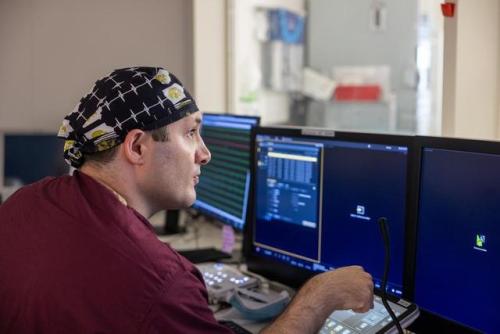
"Not only are we looking at which therapies work best but when they should be offered," Farjo says.
Because much of his work relies on retrospective analyses of large databases, Farjo’s team uses advanced statistical techniques to account for differences between patient groups and reduce the influence of confounding factors. While these studies are unlikely to change clinical guidelines on their own, they can reveal important trends and generate new questions.
“A lot of this work helps establish the groundwork for future clinical trials,” Farjo says. “It helps us identify signals, see where there may be important associations, and determine what questions we should ask next.”
Looking ahead, Farjo hopes to expand into investigator-initiated clinical trials while continuing to study the complex interactions between Afib and other chronic diseases. He is also excited by the rapid evolution of electrophysiology, particularly advances in catheter ablation technology.
Over the past decade, Afib ablation has become one of the fastest-growing areas in cardiovascular medicine. New technologies, including pulsed field ablation — a technique with roots at Iowa — are allowing physicians to treat patients more efficiently and with greater precision.
Farjo believes the future of Afib treatment will become increasingly personalized, with therapies tailored to each patient’s unique health profile and risk factors.
“The goal is to better understand the whole patient, not just their atrial fibrillation,” he says. “The more we understand those connections, the better we can target treatments and improve outcomes.”