Sections

For decades, Tammy Whitmer has lived with fibromyalgia, the long-term condition that causes widespread body pain, fatigue, and issues with sleep, thinking, and mood.

“I was diagnosed when I was around 25,” says Whitmer, 68, a retiree who lives in Muscatine, Iowa. “It was following a car accident. I learned later that something like that can trigger it. I just couldn’t get better, couldn’t feel better.”

Physical therapy and stretching exercises to treat her persistently aching lower back became a way of life for Whitmer, with mixed results. She also took trazadone, an antidepressant prescribed off label as a sleep aid, to deal with insomnia caused by the chronic pain. But this led to low blood pressure, causing fainting spells and other issues before she eventually weened herself off the medication.

“Been dealing with this for a long time,” she says.

For people like Whitmer living with fibromyalgia, persistent pain and debilitating fatigue can make everyday life — shopping, gardening, exercising, concentrating on a book or a movie, and even sleeping — feel like a never-ending ordeal.

Results from a clinical trial led by University of Iowa Health Care researchers suggest that a simple, widely available therapy can make a big difference.

The study found that adding transcutaneous electrical nerve stimulation (TENS) to outpatient physical therapy significantly reduced movement-related pain and fatigue in people with fibromyalgia, with benefits lasting at least six months. Published March 27 in JAMA Network Open, the study is the first real-world clinical trial of TENS for fibromyalgia.

Image
For Tammy Whitmer of Muscatine, Iowa, pain and fatigue from fibromyalgia made gardening and other activities she enjoyed nearly unbearable. She was one of nearly 400 participants across the Midwest who enrolled in a clincal trial of TENS (transcutaneous electrical nerve stimulation) led by researchers at Iowa.
For Tammy Whitmer of Muscatine, Iowa, pain and fatigue from fibromyalgia made gardening and other activities nearly unbearable. She was one of nearly 400 participants across the Midwest who enrolled in a clinical trial of TENS (transcutaneous electrical nerve stimulation) led by researchers at Iowa.
It is one of the few treatments that specifically targets movement-evoked pain and fatigue, which are major barriers to participation in daily activities. ”
Kathleen Sluka, PT, PhD

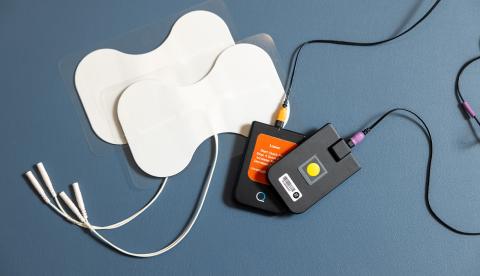
A TENS unit is a small device with adhesive electrodes that send mild electrical pulses through the skin to block or reduce pain.

“It is one of the few treatments that specifically targets movement-evoked pain and fatigue, which are major barriers to participation in daily activities,” says Kathleen Sluka, PT, PhD, professor in the UI Department of Physical Therapy and Rehabilitation Science and lead investigator of the study.

The findings are the culmination of decades of research by Sluka and her colleagues, extending from laboratory discoveries to community-based physical therapy clinics across the Midwest.

Image
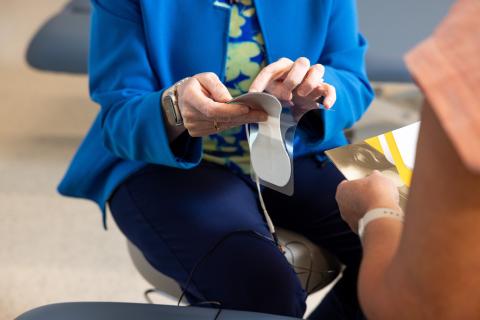
Kathleen Sluka, PT, PhD, and Dana Dailey, PT, PhD, in the Department of Physical Therapy and Rehabilitation Science at the Health Sciences Academic Building on Monday, Aug. 17, 2026. Sluka and Dailey collaborated on research that found that adding TENS (transcutaneous electrical nerve stimulation) to outpatient physical therapy reduced movement-based pain and fatigue in patients with fibromyalgia.

From basic science to human studies

When Sluka began studying TENS more than 25 years ago, clinicians and researchers were unclear about how it worked. Her lab conducted a series of studies showing that electrical stimulation activates inhibitory pathways in the nervous system to release neurotransmitters involved in pain control.

The team also learned that how TENS is delivered matters.

“Different stimulation frequencies activated different biological pathways,” Sluka says. “So, if we have these different frequencies, can we put them together to provide a greater effect?”

The answer was yes. The combined approach produced longer-lasting pain relief and reduced the likelihood that TENS would become less effective over time as the body developed tolerance to the treatment. The Sluka lab also found that stronger, but comfortable, stimulation produced the greatest benefit.

Those findings became the foundation for a series of human studies and clinical trials showing that TENS could reduce chronic pain.
Image
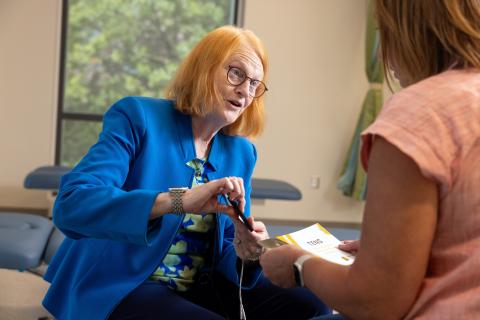
Kathleen Sluka, PT, PhD, and Dana Dailey, PT, PhD, in the Department of Physical Therapy and Rehabilitation Science at the Health Sciences Academic Building on Monday, Aug. 17, 2026. Sluka and Dailey collaborated on research that found that adding TENS (transcutaneous electrical nerve stimulation) to outpatient physical therapy reduced movement-based pain and fatigue in patients with fibromyalgia.
Image
In her Neurobiology of Pain Laboratory, Kathleen Sluka and her team focus on musculoskeletal pain mechanisms and non-pharmacological treatments for chronic pain. Her research interest in fibromyalgia dates to the start of her career, when many medical professionals dismissed the condition as a catch-all diagnosis for diffuse pain and fatigue.
Image
Kathleen Sluka, PT, PhD, and Dana Dailey, PT, PhD, in the Department of Physical Therapy and Rehabilitation Science at the Health Sciences Academic Building on Monday, Aug. 17, 2026. Sluka and Dailey collaborated on research that found that adding TENS (transcutaneous electrical nerve stimulation) to outpatient physical therapy reduced movement-based pain and fatigue in patients with fibromyalgia.

Understanding fibromyalgia

Fibromyalgia affects an estimated 4% to 7% of the population and is characterized by widespread pain, fatigue, sleep disturbances, and cognitive difficulties sometimes referred to as “fibro fog.”

Sluka's interest in the condition dates to the start of her career.

“When I started, not everyone in the medical community believed in fibromyalgia,” she says. “It was this widespread, diffuse pain. People would complain of pain in one spot and then another spot, but they didn’t have inflammation, for example. You couldn’t pinpoint a cause.”

Subsequently, she developed one of the earliest animal models of fibromyalgia-like pain, helping researchers better understand the biology behind the condition. Her team’s research pointed toward changes in the central nervous system rather than damage to muscles or joints.

“We've learned that people with fibromyalgia have an increase in central nervous system ‘excitability’ and less ability to inhibit the pain,” Sluka says.

Her lab also would discover that TENS appeared to affect these same pathways in the opposite direction — making fibromyalgia a good match for testing TENS.

Targeting pain and fatigue

One of the most important findings from Sluka's earlier work was that TENS was especially effective at reducing movement-evoked pain, the discomfort when carrying out routine activities or participating in a prescribed exercise or physical therapy program. This distinction matters because exercise is considered one of the most effective treatments for fibromyalgia, yet many patients struggle to exercise because the movement itself can trigger pain.

“Pain with movement is a huge barrier to people functioning in their daily lives,” Sluka says. “If a treatment only helps while you're sitting on the couch, that's not as meaningful as something that also helps when you're actually trying to do things.”

The Sluka team also focused on fatigue, which is experienced by nearly everyone with fibromyalgia.

“Fatigue is the No. 2 symptom,” Sluka says, “which is why we were encouraged when we looked at the results from this most recent study. We found that TENS targets whole-body fatigue as well as movement-evoked pain. That’s pretty powerful.”

If a treatment only helps while you’re sitting on the couch, that’s not as meaningful as something that also helps when you’re actually trying to do things.”
Kathleen Sluka, PT, PhD

Testing TENS in everyday practice

Although earlier clinical trials had shown that TENS could work under ideal conditions, the researchers wanted to know whether it would remain effective in routine, real-world care.

“What made this study different from all the other studies is that we wanted to see if it would work when put into actual physical therapy practice settings,” Sluka says.

The Fibromyalgia TENS in Physical Therapy (FM-TIPS) study enrolled 384 participants at 28 outpatient physical therapy clinics across six health systems. Nearly half of the participants were from rural communities, a population typically underrepresented in clinical research. Clinics ranged from urban areas, including Chicago's South Side, to towns and cities throughout the Midwest — including Whitmer’s physical therapy location in Muscatine, Iowa.

I wanted to get involved because I’ve had this [fibromyalgia] for so long. I’d used TENS before but not regularly. I just wanted to try something.”
Tammy Whitmer

The clinics were randomized to provide either physical therapy with TENS or physical therapy by itself. Whitmer was part of the physical therapy-only cohort. However, after the main randomized part of the study — the first 60 days — all study participants, including Whitmer, received TENS and evaluated its effectiveness.

“I wanted to get involved because I’ve had this for so long,” Whitmer says of her participation in the study. “I’d used TENS before but not regularly. I just wanted to try something.”

The researchers intentionally designed the study to reflect ordinary practice. Physical therapists were free to treat patients as they normally would, and participants continued using medications and other remedies. Participants in the TENS group were asked to use the device for two hours a day while receiving physical therapy.

Strong results and lasting benefits

After 60 days, participants receiving physical therapy plus TENS reported significant improvements in movement-evoked pain. They also reported reductions in resting pain, movement-related fatigue, and resting fatigue.

Participants receiving physical therapy without TENS showed no improvement in movement-related pain during the randomized phase of the study. After the initial 60 days, participants in this physical therapy-only group also received TENS devices.

“When we gave the PT-only patients a TENS unit and they started using it, we also saw the same improvements as the PT with TENS patients,” Sluka says.

Overall, 80% of the study participants found TENS helpful. At six months, 80% were still using the device at least once each week, and more than 70% reported that they felt better after using it.

“To see such a high percentage of patients still using TENS after six months and still finding it beneficial — that’s pretty remarkable,” Sluka says.“

Image
Tammy Whitmer continues to use TENS in combination with physical therapy to help reduce pain associated with fibromyalgia, allowing her to enjoy gardening and playing with her dogs, Bentley and Samson
Tammy Whitmer continues to use TENS in combination with physical therapy to help reduce pain associated with fibromyalgia, allowing her to enjoy gardening and playing with her dogs, Bentley and Samson.

Another tool in the toolbox

TENS is not a cure for fibromyalgia but part of a multipronged treatment strategy that can be safely and easily used as a self-management tool by patients.

Dana Dailey, PT (13PhD), assistant research scientist at the UI and first author of the JAMA Network Open study, notes that using TENS on its own will not provide the same benefits.

“However, the study shows that TENS can provide an added benefit on top of any relief from other treatments,” Dailey says. “All the study participants were also using pain medications and receiving physical therapy, yet TENS still provided additional relief.”

Image
Kathleen Sluka, professor in the Department of Physical Therapy and Rehabilitation Science, and Dana Dailey, assistant research scientist in the department, led the Fibromyalgia TENS in Physical Therapy study, which enrolled participants at 28 outpatient physical therapy clinics. The researchers intentionally designed the study to reflect real-world clinical settings.

Whitmer continues to use her TENS unit as needed.

“For me, it’s not an everyday thing anymore,” she says. “It’s definitely helped. I’m now more active outside, and I do gardening and stuff like that. I still have some discomfort, but it’s not so painful that I can’t do those things.”

TENS is “another tool in the toolbox for patients to control their pain,” Sluka says.

Looking ahead, the Sluka lab will explore biomarkers, immune system changes, and other biological clues that may improve fibromyalgia treatment. For the research team, the JAMA Network Open study validates years of work in the lab and in real-world clinical settings, culminating in patients using TENS successfully in their own homes.

“Often, when you move a randomized, controlled clinical trial into a real-world setting, it doesn't work because there are too many confounding factors,” Sluka says. “But this intervention still works.”

Scientist and artist

Kathleen Sluka is an accomplished researcher and expert on the peripheral and central mechanisms of chronic musculoskeletal pain. She’s also an artist who uses acrylic paint and mixed media to create visually arresting images that interpret the nervous system, molecular biology, and pain-related conditions.

She took art classes while growing up and maintained an appreciation for art even as she embarked on a career in biomedical sciences. About a decade ago, she rediscovered her artistic temperament and began painting to explore her work as a scientist.

“It finally dawned on me that, when everybody says paint what you know, well, I’m a scientist, I should paint science,” Sluka told Iowa Magazine in a 2022 profile.

Sluka shared several images, two of which are depicted here with her notes:

Pain

Chronic pain affects nearly 100 million Americans and costs over $600 billion per year in health care and lost wages. Pain is a unique experience that can affect all aspects of a person’s life from the sensation itself to impacts on work, family, and society. Forefront research efforts are under way to develop a better understanding of pain and novel approaches to its management.

Image
Painting by Kathleen Sluka titled "Pain"

Analgesia

The companion piece to Pain, Analgesia represents the opposite. While pain is associated with chaos, inflammation, fear, anger, and stress, pain relief is associated with order, calm, and peace. Using ice as the inspiration, which is a classic pain relief method, this painting highlights the role of the nervous system in the generation of analgesia.

Image
Companion piece to Pain, Analgesia