Sections

Growing up in Huntington, New York, Jocelyn Meagher was fascinated by all things STEM and thought she might want to be an engineer. She was also a pretty good athlete, enjoying lacrosse, hockey, and swimming.

But her life changed dramatically at her first middle school cross-country meet when she was hit with an intense headache; her legs felt numb, and she almost passed out.

Alarmed, Meagher’s mother took her to the doctor, who quickly discovered that Jocelyn had high levels of blood and protein in her urine — a telltale sign of kidney problems. A biopsy yielded the diagnosis of C3 glomerulonephritis (C3GN), an ultra-rare, life-threatening kidney disease that affects only one to three people in a million.

C3GN is one of two forms of C3 glomerulopathy (C3G). Around 5,000 Americans have C3G, which primarily affects children and young adults and causes progressive kidney damage. More than half of patients reach end-stage kidney failure within a decade of diagnosis.

There was no cure for either form of C3G, so Meagher began a long and difficult medical journey involving multiple medications to keep the symptoms of the disease at bay and possibly slow the progressive damage to her kidneys.

I was tired all the time, and I was extremely, extremely swollen to the point where it would hurt to walk or stand up for too long. My circulation was so bad, and I had such pain in my ankles from all the swelling — I basically didn't have ankles.”
Jocelyn Meagher

Over the next eight years, she tried nearly every available therapy. Initially, she took the steroid prednisone and the hypertension drug lisinopril to lower her blood pressure and try to control her urine protein. After Meagher and her family moved to Southlake, Texas, her nephrologist there put her on a series of powerful immunosuppressants: CellCept, rituximab and eculizumab—often in combination. None provided lasting benefit. Many of these drugs had side effects, and some worsened her protein leakage, which at one point reached 5,000 mg per day compared to a normal level of 100 mg.

As the disease progressed, it took a heavy toll on Meagher’s health and daily life.

“I was tired all the time, and I was extremely, extremely swollen to the point where it would hurt to walk or stand up for too long,” she says. “My circulation was so bad, and I had such pain in my ankles from all the swelling — I basically didn't have ankles.”  

Around two years ago, as her kidney function worsened, her nephrologist decided that Meagher needed more options and referred her to Carla Nester, MD, an adult and pediatric nephrologist at University of Iowa Health Care and a world leader in C3G care, for a second opinion.

Finding answers in Iowa

The visit to Iowa City was a revelation.

“Dr. Nester is probably the best doctor I have ever met, and I've seen a lot of doctors,” Meagher says. “Her bedside manner is incredible, and she's so kind. I love how she draws things out for me on her whiteboard and really explains to me how things work.”

Nester directs the Rare Renal Disease Clinic at UI Iowa Health Care, one of a very few centers in the U.S. capable of providing complete care to patients with C3G, including efficient diagnosis and state-of-the-art management of the disease. The UI’s clinical leadership in C3G is complemented by its world-renowned expertise in scientific research into the underlying causes of C3G, led by Nester’s colleague Richard Smith, MD, UI professor of otolaryngology and director of the Molecular Otolaryngology and Renal Research Laboratories (MORL).

Thanks, in part, to decades of pioneering translational work by Smith and Nester at UI Health Care, two new, first-of-their-kind, therapies for C3G had become available in 2025: iptacopan (Fabhalta) and pegcetacoplan (Empaveli).

This is the closest thing to a cure we’ve ever seen for this disease.”
Carla Nester, MD

The visit to Iowa City convinced Meagher and her family to put their faith in the UI’s expertise. Although Meagher had already tried one of the new drugs, which unfortunately did not work for her, Nester was able to enroll her in a research study of the other new therapy for C3G. Meagher started the new medication on her 19th birthday, and after eight long years of trial and error, that drug became the first therapy to effectively control her condition.  

“This is the closest thing to a cure we’ve ever seen for this disease,” Nester says.

Image
Jocelyn Meagher traveled to Iowa around two years ago to see Carla Nester, MD, and received a new therapy for C3G, a rare kidney disease. on Friday, Sept. 11, 2026. She has since transferred to the University of Iowa, where she is studying biomedical engineering as a pre-medicine student.
The level of trust that led Jocelyn Meagher to transfer her care from Texas to the Rare Renal Disease Clinic at UI Health Care also inspired her to relocate to the Midwest. Today, she’s a biomedical engineering and pre-med student at Iowa.

Fateful diagnosis turns UI into powerhouse for C3G research

It was another fateful diagnosis that turned Iowa into a global center for research and treatment of C3G.

In the early 1990s, Smith’s daughter, Jenna, was diagnosed with a form of C3G called dense deposit disease (DDD). Smith’s training as a physician-scientist kicked in, and he sought expertise on the disease.

As a parent, however, he was dismayed to learn that very little was known, and there were no effective therapies.

That daunting realization set Smith, a genetics expert, on an almost three-decade-long scientific quest to find answers. Along the way, he forged a powerful coalition of researchers and clinicians, families, advocates, and philanthropists who have driven the research forward.

Thanks to this coalition and to the pioneering research and clinical leadership from Smith and Nester at UI Health Care, the first disease-specific treatments for both children and adults were approved by the U.S. Food and Drug Administration in 2025.

Unlike previous treatments that aimed to alleviate the damaging inflammatory process of the disease, the two new therapies, iptacopan and pegcetacoplan, directly target the root cause of C3G: dysfunction in the body’s complement system, which is part of the immune response that helps fight infections.

C3G occurs when the complement system becomes overactive. Once activated, the immune system of patients with C3G fails to shut down properly, and the excess activity begins to create many byproducts of complement activity, such as protein complexes and breakdown products, that build up in the kidneys. These deposits damage the kidneys’ filtering units, called glomeruli, compromising their ability to filter the blood to make urine. Continued excessive complement activity and accumulating kidney damage can lead to blood and protein in the urine, worsening kidney function, and ultimately kidney failure. Excess complement activity is why many patients with C3G have low levels of complement C3 in the blood because C3 is being depleted due to dysregulation of the alternative pathway of complement.

For patients, the impact of these new medicines, which precisely inhibit the malfunctioning part of the complement system, is profound.

“This disease has had a huge impact on the quality of life of young patients like Jocelyn Meagher. Not only because they had to deal with the frequent need for medical interventions, including hospital admissions and therapies that had challenging side effects, but on top of that there is a psychological toll of knowing that the therapies being used had a lousy track record,” Nester says. “Basic research has been going on for this disease for decades, but it wasn’t until this past year that finally we can help these patients. It’s been a long road, but it feels like we are finally where we need to be.”

A winding path to discovery

In the early 1990s, Smith had moved to the UI to set up his lab focused on the genetics of hearing loss. Faced with his daughter’s diagnosis and the lack of understanding of C3G, Smith tackled the problem in the way that made the most sense to him.

“There was not very much research done on C3G, and so I thought ‘I can do that,’” he says.

His lab pivoted to include research on C3G and related renal diseases. Today, the Molecular Otolaryngology and Renal Research Laboratories is renowned as a global leader in complement-mediated kidney diseases. The new, FDA-approved therapies are grounded in foundational research on the complement system led by Smith and his team.

“The MORL is the cornerstone of this work,” Smith says. “The group of people in the lab who are working on C3G are unrivaled anywhere in the world. They are the heart and soul in providing the best genetic testing and clinical diagnostics for people faced with this disease.”

Image
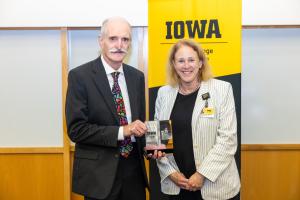
Distinguished Mentor Award Celebration honoring awardee Richard Smith, MD, at Prem Sahai Auditorium on Tuesday, Sept. 15, 2026.

In September, Richard Smith received the 2026 Daryl and Nancy Granner Distinguished Mentor Award. Throughout his career, Smith has created opportunities for trainees at every stage to learn, grow, and connect. He fosters a team-based approach — working closely with team leaders who, in turn, mentor the members of their teams. The result is a culture of service and collaboration that extends throughout the lab.

Patients, families, philanthropy help drive C3G research

But Smith also wanted to grow the field of C3G research beyond Iowa. He and his wife, Lynne Lanning, started a nonprofit organization called Kidneeds to help raise funds for research focused on the disease. Since 1997, Kidneeds has awarded $2.75 million in research grants that have helped advance knowledge on C3G, including identifying the faulty complement mechanisms targeted by the new drugs.

A key component of the progress made in C3G rests on the close collaboration between the UI researchers and the patients and families affected by the disease. This connection also grew out of the Kidneeds initiative. Every year, Smith and Nester host an annual C3G/DDD family conference and have built a community of families across the country and around the world who have helped inform the research. In the fall of 2025, Iowa hosted the 20th C3G Annual Family Meeting.

“The purpose is to provide families with a clear understanding of what we know about C3G and where we are heading,” Smith says. “But the meetings are also a great source of emotional support — many attendees have been coming for years — and really, we are one big family.”

Building a community of supporters is important for researchers, too. When philanthropist Sean Tully, whose family was also affected by C3G, reached out to Smith to ask how he could help advance the research, Smith recommended a fund that would support scientific meetings.

Like the family meetings, Smith intrinsically understood the value of fostering social connections among the C3G research community.

“Trust is vital for scientific collaboration,” he says. "You're not going to tell somebody your deepest, neatest scientific thoughts unless you trust the person.”

Tully established the Milagros Fund to support C3G scientific meetings. Over the years, with Milagros support, Smith has organized seven international scientific meetings that have been instrumental in building a diverse community of researchers focused on different aspects of C3G to propel the science forward.

Becoming a global leader in rare kidney disease

In line with his instinct to gather the right people and resources to find answers for C3G, Smith recruited Nester, a physician-scientist and nephrology expert, to Iowa in 2007 where she established the Rare Renal Disease Clinic at UI Health Care Stead Family Children’s Hospital.

“With my nephrology background as a complement to Richard’s basic science expertise, we were able to create this unique, niche center of excellence in kidney and complement disease,” Nester says.

The Rare Renal Disease Clinic at Iowa is a premier center for providing care to patients with C3 glomerulopathy, and Smith’s MORL lab is a leading center in the U.S. for providing complement biomarker assays necessary to evaluate this disease. The lab has accumulated samples, data, and medical histories from hundreds of patients, which is invaluable for advancing understanding of such a rare disease.

Iowa’s reputation as a center of excellence for C3G research and clinical care — along with the community-building work of the family conferences and the researchers’ strong personal ties with the C3G community — earned the trust of patients and families affected by C3G. Patients travel from across the country and around the world to seek care at Iowa.

“One of our patients used to fly in from Qatar to be seen in our clinic, and another moved from Europe to be under our care,” Nester says. “That’s how well known and trusted our program has become.”

That same trust inspired Meagher to transfer her care to Nester’s clinic and to relocate to Iowa City, as well. During her family’s first visit to meet Nester, she remembers her mother’s reaction.

“My mom and I were so happy that my mom said, ‘You know what? Let's look at the campus.’ So, we did, and we fell in love with it,” she says.

Meagher transferred to the UI in fall of 2025 as a biomedical engineering and pre-medicine student. Being under the care of Nester and her team at UI Health Care gives Meagher and her family extra peace of mind.

With my nephrology background as a complement to Richard’s basic science expertise, we were able to create this unique, niche center of excellence in kidney and complement disease.”
Carla Nester, MD

Trust boosts clinical trial participation

.

Testing therapies for rare diseases is particularly challenging because it is difficult to recruit enough study participants to demonstrate that a therapy is effective. With C3G, the decades spent building trusted relationships with families affected by the disease helped raise awareness of the research progress and inspired confidence among patients to participate in clinical trials.

The UI was the lead recruitment center for the VALIANT trial, which tested pegcetacoplan in children, and the APPEAR-C3G study, which tested iptacopan in adults. These two trials provided robust evidence of the drugs’ efficacy and led to FDA approval of both medicines.

Nester described the results of the global pediatric VALIANT trial she led as striking: There was a 68% reduction in the amount of protein in the patients’ urine and stabilization of kidney function. Up to 36.5% of patients achieved complete remission, and 72% showed no C3 deposition on their kidney biopsies

“We still need to follow the long-term outcomes for these patients, but the data from this trial are absolutely amazing,” she says about the study, which was published in December 2025 in the New England Journal of Medicine.

The APPEAR-C3G study, which both Smith and Nester were involved in, found similarly strong results for the drug iptacopan in adult patients. Those findings were published October 2025 in The Lancet.

Image
Cobey Heinen Donelson, PhD student in the Biomedical Science Graduate Program, views kidney cells in the Richard Smith lab on Wednesday, Sept. 9, 2026.

Supporting drug development

The research from Smith’s lab over many years advanced understanding of the underlying biology of C3G and led to a realization that inhibiting excessive activation of the complement pathway by precisely blocking the malfunctioning part of the system was the key to an effective treatment.

Initially, Smith considered focusing his team’s research on developing drugs for C3G. But the complexity of the complement system, with multiple redundant pathways, meant that identifying a successful drug target was extremely challenging.

“You have to guess which target to go after, and given the complexity of the complement system, there's a fair chance your guess will be wrong. We didn't have the resources to effectively pursue multiple targets,” he says. “But what we did have was the best biobank in the world on C3G, with more samples, more cells, more serum, and more DNA on C3G than anybody else. We decided that we could better use our resources and expertise to help companies as they developed and tested drugs.”

Smith allowed drug company scientists to visit his Iowa lab and make use of these resources and his team’s expertise to do early-stage testing of drug compounds. The MORL lab was involved in the early-stage testing of both iptacopan and pegcetacoplan.

“I like to think that while we didn’t develop anything ourselves, we've helped everybody else move things forward,” Smith says.

It really comes down to understanding the very complicated landscape of the complement system and how to manipulate it. But we've got more intellectual horsepower in the MORL today than we've ever had, and we're figuring all this stuff out.”
Richard Smith, MD

These two new treatments are just the first step for Smith. There is still much to learn about how the therapies will work over the long term and which patients will benefit most from them. In addition, there are many more drug targets to be identified within the complement system, and there are more treatments in the pipeline.

“It really comes down to understanding the very complicated landscape of the complement system and how to manipulate it,” Smith says. “But we've got more intellectual horsepower in the MORL today than we've ever had, and we're figuring all this stuff out.”

For patients like Meagher, the UI team’s ability to “figure it out” has meant a new lease on life.

Since starting the new medication, Meagher’s swelling has resolved, her energy has returned, and she can stand for long periods. Importantly, her kidney function has improved significantly, giving her and her family renewed hope for a bright future.

The new therapy has allowed her to reduce her other medications and concentrate on enjoying college life and pursuing a career in medicine – possibly in nephrology, shaped by her firsthand experience with complex kidney disease and innovative therapies.

“Entering a medication trial can be scary. But I am glad that I was brave enough to do that because it has really helped me in the long run,” Meagher says. “I am so thankful for the work that Dr. Nester and Dr. Smith and their teams have put in to find this option for people like me.”