Expanded unit meets growing need for specialized neonatal care
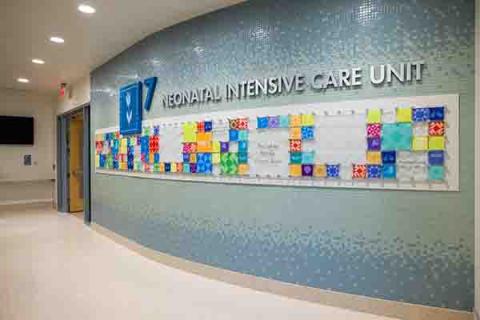
University of Iowa Health Care Stead Family Children’s Hospital welcomed patients and families to its newly expanded neonatal intensive care unit (NICU) in early March. A built-out space on Level 7 of the children’s hospital allows the nationally ranked neonatology program to care for more premature and high-risk infants and meet Iowa’s growing need for highly specialized newborn care.
Stead Family Children’s Hospital has some of the highest survival rates in the country for extremely premature infants. It is home to Iowa's only nationally ranked Level 4 NICU — the highest level recognized by the American Academy of Pediatrics — which means it is equipped to care for the tiniest and most critically ill babies with the greatest range of neonatal services.
“Expanding our NICU represents a major milestone for families across Iowa and for our children’s hospital,” says Denise Jamieson, MD, MPH, UI vice president for medical affairs and the Tyrone D. Artz Dean of the Carver College of Medicine. “As access to maternal and newborn care remains limited in many communities, we are seeing more complex pregnancies and babies who need our advanced neonatal services. These new spaces ensure we can expand access while continuing to deliver the highest level of care for our most vulnerable patients.”
Designed for high-acuity neonatal care, training
The opening of Level 7 marks the halfway point for a two-part expansion within Stead Family Children’s Hospital that includes Level 8, which is slated for completion later this year. Built in 2017, the Stead Family Children’s Hospital’s seventh and eighth floors were originally constructed as shell spaces for future expansion. The completion of Level 7 will host 32 NICU beds, plus dedicated support spaces, family waiting areas, and provider work rooms that will increase capacity while enhancing the care environment for patients, families, and team members.
“We have a team of world-class neonatologists, and this expansion allows us to continue providing world-class care,” says Patrick McNamara, MB, BCh, division director of neonatology. “The completion of Level 7 gives our teams the space and infrastructure they need to respond quickly, work efficiently, and deliver highly specialized care to the most premature and medically complex newborns in Iowa and the region.”
The Level 7 NICU is designed to support the complex, team-based care required for critically ill and extremely premature newborns. In addition to increasing bed capacity, the new environment improves workflows, proximity of specialty services, and communication among multidisciplinary teams.
"Our goal is not only to help babies survive, but to give them every opportunity to thrive —strengthening collaboration and advancing the specialized care that defines our program,” says Brady Thomas, MD, NICU medical director.
Centralized support services improve efficiency
Among the NICU’s specialized services is neonatal hemodynamics, which monitors a baby’s cardiovascular health to deliver safer and more accurate care. UI Health Care neonatal specialists are at the forefront of implementing this advanced imaging technique while also educating and training NICU teams from around the world.
“To successfully care for such tiny, fragile babies, we need the most advanced technology, and these new spaces are designed to support the infrastructure needs of such essential equipment,” says Danielle Rios, MD, MS, director of the neonatal hemodynamics program.