
Table of ContentsClose
Headache resilience
UI researchers bridging molecular and neural circuit neuroscience to foster precision medicine therapies for migraines
Andrew Russo, PhD, has spent much of the past 40 years on groundbreaking basic science research on a neuropeptide linked to migraine disorders. This work yielded great rewards: In 2018, the U.S. Food and Drug Administration (FDA) approved the first-ever migraine prevention drug, erenumab (Aimovig), that was partly borne out of Russo’s research. He and colleagues in his lab also hold two patents related to the development of eptinezumab (Vyepti), another migraine-prevention therapy that was approved by the FDA in 2020.
Today, there are eight related treatments on the market. These CGRP (calcitonin gene-related peptide) inhibitors, taken as oral medications or monoclonal antibody injections, prevent migraines or ease symptoms in about half of people with migraine disorder, including two of Russo’s three daughters who have experienced migraines.
“I feel like I backed the right horse,” says Russo, a professor in the Department of Molecular Physiology and Biophysics at the University of Iowa Carver College of Medicine.
Still, millions of people with migraine — a neurological disorder so devastating that the World Health Organization designated it in the same class of disability as quadriplegia and terminal cancer — continue to experience this debilitating neurological condition. That’s because it can take months, or even years, to find the right migraine treatment, whether it’s CGRP inhibitors, beta-blockers, antidepressants, neuromodulation, or something else.
To take the next step in migraine research and treatment, Russo is collaborating with a new generation of scientists who bring complementary skills and technical expertise that weren’t conceivable when he joined the UI faculty in 1988. Rainbo Hultman, PhD, assistant professor in the Department of Molecular Physiology and Biophysics, and Levi Sowers (12PhD), assistant professor in the Stead Family Department of Pediatrics and its Division of Child Neurology, are working with Russo to build on his research, integrating their own distinct neuroscience specialties. Like Russo, Hultman and Sowers have deep emotional connections to their work.
“I’m very lucky to have them as colleagues,” Russo says. “There’s so much more we can do as a group.”
Through their collaboration, the Iowa researchers ultimately look to bring a new dawn in migraine treatment: a precision approach that connects individual patients with treatments personalized for them.
Common, debilitating, and stigmatized
Headache disorders affect more than 4 billion people worldwide — roughly half of the global population. About one-third of those with headache disorders experience migraine.
While best known for causing severe headache pain, migraine symptoms can also include nausea, vomiting, and sensory sensitivities, particularly to light and sound.
“She just never liked the light,” Russo says of his mother, who kept the curtains drawn in his childhood home. Like millions of others, her migraine disorder went undiagnosed for years. More common in women, migraine was historically dismissed, according to Russo.
“Think of the fainting Victorian lady unable to deal with life,” he says. “From a scientific perspective, it wasn’t recognized as a real biochemical disorder.”
Migraine has sidelined members of Hultman’s family for generations. Her grandmother’s sister, she says, “missed out on much of her life with frequent debilitating migraine attacks over decades of her life.” Hultman recalls anecdotes from her mother and her mother’s siblings describing migraines so debilitating that they would interfere with work and family activities. Triptans — a class of prescription medications to treat migraines that became more accessible in the late 1990s — provided some relief. Now, Hultman and her siblings’ and cousins’ generation have access to CGRP inhibitors, which have transformed the treatment landscape.
A foundation of research
Hultman’s family history inspired her to bring her expertise in systems neuroscience to migraine research. She understood that multiple brain regions and neural circuits were working together during a headache.
“People are having symptoms of nausea and sensitivity to different sensory modalities. They’re having pain and emotional changes. They’re yawning or can’t find their words,” she says. “It was clear to me that this is a systems neuroscience problem.”
Sowers, who maintains a strong commitment to Veterans, has a particular interest in post-traumatic headache triggered by traumatic brain injury. Post-traumatic headache produces symptoms similar to migraine, but FDA-approved treatments such as CGRP-inhibitors don’t tend to work in these patients. In his UI lab, affiliated with the U.S. Department of Veteran Affairs, Sowers studies the brain mechanisms behind sensory symptoms of post-traumatic headache.
Russo’s CGRP breakthrough came when human studies suggested that sensitivity to the neuropeptide was implicated in migraine. To prove it, Russo developed genetically altered mice with overexpressed levels of CGRP receptors. It was a controversial idea at the time.
“There was a lot of doubt about whether animals actually get headaches,” he says, “which is extremely ethnocentric of us to think evolution has favored humans with headache.”
Hultman recalls her “armchair interest” in Russo’s CGRP research as a graduate and postgraduate student at Duke University.
“Anytime there is something that exciting and impressive, I know it comes with a lot of haters along the way,” says Hultman, who came to Iowa, in part, to access Russo and his work. “I’m so thankful he stuck with it.”
Sowers trained in Russo’s lab, and the two studied another neuropeptide, PACAP (pituitary adenylate cyclase-activating polypeptide), which is also implicated in headache. They patented a PACAP drug that is now in Phase 2B clinical trials testing the drug’s efficacy and optimal dosing.
But, as with CGRP, not everyone with migraine is responsive to PACAP. Hultman wondered what makes some mice, or humans, more resilient to migraine-inducing neuropeptides than others.
Together, the trio “came together through this idea of headache resilience,” Sowers says.
Triple-teaming the problem
What does it mean to study headache resilience? The researchers’ overlapping approaches to neuroscience will paint a never-before-seen picture of the micro-connections, macro-level organizational networks, and genetic foundations of what’s happening in the brain during migraine.
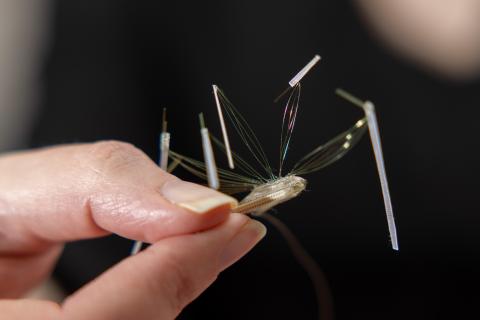
Russo will build on his research on gene expression in PACAP responder and non-responder mice by zeroing in on different regions of the brain. Hultman’s lab will measure electrical neural signals to predict which animals are resilient to migraine. Sowers, who has used small-animal functional MRIs in his post-traumatic headache research, will begin to translate the neurocircuitry from mice to humans.
“It’s very unique to bring three people with the expertise we have together to do what we’re doing,” Sowers says.
This research approach wouldn’t be possible without Hultman and Sowers’ contributions, Russo emphasizes.
“It’s amazing what [Hultman] can do with those electrodes,” he says. “[Sowers] has the expertise to use advanced techniques like fMRI in mice. I, and other colleagues, tried doing fMRI in mice years ago. At that time, the tools were not there.”
Now those tools are available at the Iowa Neuroscience Institute at the UI, which awarded the group one of its Research Programs of Excellence, funded through the Roy J. Carver Charitable Trust.
“Iowa and the Carver Trust have made a real commitment to neuroscience research,” Russo says. “It has helped us make advances, and it’s helping us now move forward, which we wouldn’t be able to do with one lab on its own.”
Other UI members of the headache resilience research group include Aaron Boes, MD, PhD, professor in the Stead Family Department of Pediatrics–Neurology; Deema Fattal, MD, clinical professor in the Department of Neurology; Jake Michaelson, PhD, professor in the Department of Psychiatry; and Sanvesh Srivastava, PhD, associate professor in the Department of Statistics and Actuarial Science in the UI College of Liberal Arts and Sciences.
Boes’ epilepsy research involves implanted electrodes that record electrical activity in patients’ brains. People with epilepsy also often experience migraine, so the headache resilience team will collect data from Boes’ subjects that will help inform their understanding of brain activity during migraine.
Personalized medicine for migraine disorders
In studying headache resilience, the group isn’t necessarily aiming to develop new drug targets, though that’s a possibility. Their main objective is to connect migraine patients with the best available treatments.
“We’re collecting data on how existing medications impact different brain network activities,” Hultman says. “Within a couple of years, we could have some ability to predict the current therapeutics matching with specific brain network activities.”
This means, because migraine is different for each patient, treatment won’t be the same for everyone. A patient might be tested with electroencephalography and fMRI and determined to have a “type 1” migraine, which responds best to a specific drug. Another patient, found to have “type 2” migraine, may be treated with monoclonal antibodies, while a third patient may be a candidate for neuromodulation stimulation.
“We’re trying to push the boundaries of what we know, what we can learn, and how this may inform therapies for headache disorders, including migraine,” Hultman says.
The problem is urgent. The more episodes of migraine a person experiences, the more likely their condition will become chronic, especially if the migraines start in childhood. Getting someone on a successful treatment sooner dramatically increases the likelihood that they will find relief, according to Hultman.
“There is this great need for precision medicine where you can intervene early and get the right answer for that specific patient right away,” she says.