Sections

UI Health Care receives Specialized Program of Research Excellence funding for neuroendocrine tumors

In fall 2025, researchers with University of Iowa Health Care Holden Comprehensive Cancer Center were awarded a five-year, $10.7 million Specialized Program of Research Excellence (SPORE) grant from the National Cancer Institute to study new, targeted therapies for neuroendocrine tumors (NETs), which are cancers that form in neuroendocrine cells. These cells function as nerve cells that receive and send signals from the brain and as endocrine cells, which produce hormones that regulate certain body functions.

SPOREs are awarded to institutions with multidisciplinary teams of researchers and clinicians who collaborate on a single cancer area to translate discoveries into clinical practice.  

This is the second SPORE award focused on NETs for researchers at Iowa. The first SPORE award, which ran from 2015 to 2022, was the first and only award focused specifically on NETs, despite federal funding for more than a thousand SPORE awards since the program’s inception in 1992.

The first NET SPORE built upon clinical and basic science expertise that coalesced at Iowa in the early 2000s.  

In 1999, M. Sue O’Dorisio, MD, PhD, a pediatric medical oncologist, and Thomas O’Dorisio, MD, an endocrinologist, came to Iowa from Ohio State University, bringing their NET experience with them. They recognized the need for a comprehensive center to expand understanding of NETs that could lead to better treatment options. 

They grew the NET program, which included the formation of a tissue bank of NET samples, and established a multidisciplinary team of research collaborators, including nuclear physicists, peptide chemists, genetics experts, molecular biologists, epidemiologists, and bioinformatics specialists.

There were only half a dozen places in the country that, at the time, had real expertise on this type of cancer.”
Joseph Dillon, MD

They also formed the Iowa Neuroendocrine Tumor Clinic, a multidisciplinary team of NET physicians and experts in adult and pediatric surgery, nuclear medicine, medical oncology, endocrinology, pathology, radiology, and other specialties. The team led or participated in clinical trials of new radiopharmaceuticals — drugs that deliver radiation directly to cancerous cells and tumors. Many of these investigational therapies weren’t available anywhere else in the U.S. 

The NET clinic “attracted people from all over,” says UI endocrinologist Joseph Dillon, MD, professor of internal medicine and director of the clinic. “There were only half a dozen places in the country that, at the time, had real expertise on this type of cancer.” 

The O’Dorisios’ work focused on a receptor on the tumor’s surface, which had been identified as a useful target for diagnosing and treating the cancer. Through their work, they were able to bring peptide receptor radionuclide therapy (PRRT), which binds to receptors on neuroendocrine tumor cells to kill them and slow tumor growth, to the U.S. after it had already been approved in Europe.

Ron Muhlenbruck of Osage, Iowa, was a participant in the clinical trials that established the treatment’s safety in the U.S.

“My finish date in March 2018 was the same day the Food and Drug Administration approved PRRT to the rest of the United States,” he says. “That was the highlight of being in the clinical trial.” 

Image
Ron Muhlenbruck in his home

NET patient — and research advocate

When Ron Muhlenbruck was diagnosed with neuroendocrine tumors in his small intestine and on his liver in 2005, there was no question of where he was going for care, given that UI Health Care was established as a leading center for treating these types of cancers.

The NET SPORE has four overarching goals

  • Support innovative NET translational research
  • Promote translational NET research through collaborations that result in new treatments and evidence-based guidelines for patients
  • Enlist and encourage new translational researchers in NETs through developmental research and career enhancement programs that lead to independent research funding
  • Provide support through interactive core research facilities and programs

Second SPORE

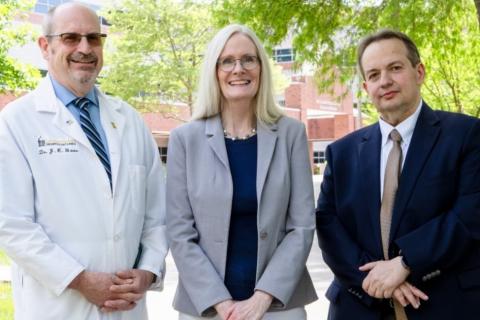
For the current NET SPORE grant at Iowa, funded through 2030, the co-principal investigators are Dawn Quelle, PhD, professor of neuroscience and pharmacology, James Howe, MD, professor of surgery–surgical oncology and endocrine surgery, and Yusuf Menda, MD, professor of radiology–nuclear medicine. 

Since its inception, the NET SPORE at Iowa has funded important new collaborations with research centers from across the U.S., including Emory University and Yale University — with the goal of better understanding the disease and developing new therapies for people with NETs. The goals and framework of the second SPORE grant bring together over 20 faculty at Iowa, along with collaborators at Rutgers University. 

“It’s a large grant for a rare tumor type where funding has been difficult to come by,” Howe says. 

Image
NET Spore Team
The current SPORE grant — led by co-principal investigators (from left) James Howe, Dawn Quelle, and Yusuf Menda — will involve the work of more than 20 faculty members at Iowa with the goal of translating research into new treatments for neuroendocrine tumors.

TRANSLATIONAL PROJECTS

The grant will support three specific research projects, with the goal of translating findings from the laboratory into new or enhanced treatments for NET patients: 

  • Improving immunotherapy in pancreatic NETs: Led by Quelle and colleagues at Rutgers, this project aims to improve the efficacy of immunotherapy for pancreatic NETs through a new strategy of sensitizing the tumors to immune-enhancing (immune checkpoint inhibitor) therapy. If successful, this would deliver a tumor-killing blow while sparing normal tissues.
  • Targeting CXCR4 and redox metabolism for alpha particle therapy of pulmonary NETs and carcinomas: Led by Menda and Doug Spitz (84PhD), professor of radiation oncology, the goal of this project is to develop a new treatment paradigm for patients with lung neuroendocrine cancers by combining drugs that induce metabolic stress with radioligand therapy that targets a novel biomarker specific to these tumors.
  • GLP-1R/GIPR agonists in promoting gastroenteropancreatic (GEP) NET progression: Led by Howe, Dillon, and Po Hien Ear, PhD, assistant professor of surgery–surgical oncology and endocrine surgery, this project examines whether commonly used diabetes and obesity drugs, known as GLP-1 and GIP receptor agonists, inadvertently promote GEP neuroendocrine tumor growth, since some NETs express these receptors on their tumor surfaces.   

CORE SUPPORT

A key aspect to the NET SPORE at Iowa is the implementation of interactive core research programs and services to support the research teams: 

  • Administrative Core: Facilitates communication and collaboration between projects, cores, and collaborators
  • Biospecimens Core: Provides access to multiple sources of rare NET tissue and guides their scientific use while providing accurate tumor classification for all specimens
  • Administrative Core: Facilitates communication and collaboration between projects, cores, and collaborators
  • Biospecimens Core: Provides access to multiple sources of rare NET tissue and guides their scientific use while providing accurate tumor classification for all specimens  

Developing next-gen science (and scientists) in NET research

Pushing the boundaries of NET research and developing future leaders are also part of the NET SPORE. A developmental research program, led by Quelle and Menda, will look to bring new ideas and innovative techniques to shape diagnosis, therapies, and potential prevention of neuroendocrine tumors. The long-term goal is to translate findings generated from developmental projects into improved quality of life for patients. 

Additionally, Quelle and Howe will lead a career enhancement program to develop early-career scientists. Just as the current team of NET researchers benefited from the collaboration and expertise of Tom O’Dorisio, who died in 2022, and Sue O’Dorisio, who died in late 2025, the NET SPORE team is committed to recruiting and developing new investigators into translational NET research and infusing the field with fresh approaches and innovative ideas.

To support neuroendocrine tumor research at Iowa, visit givetoiowa.org.

Give today

Image
Block Iowa logo